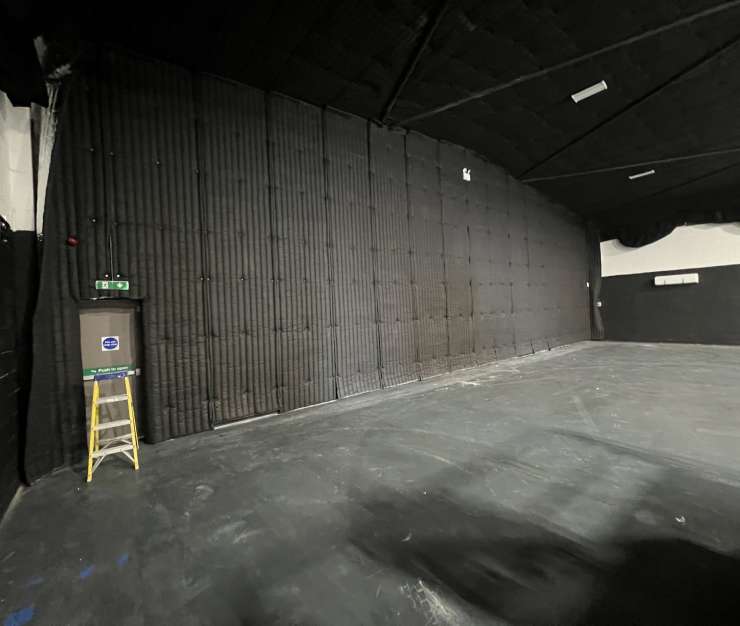

The most effective way to reduce rain noise on metal roofs is to stop raindrops hitting the roof sheet at full force. External matting such as Silent Roof Material (SRM) does this from the outside, while internal insulation and acoustic linings deal with some of the noise once it is already inside. Which approach suits you depends on the building, how it is used and how quiet it needs to be.
Why metal and fibre cement roofs are so loud in rain
Profiled metal and fibre cement sheets are popular because they are light, strong and quick to install. Their lightness is also what makes them noisy in rain. Each raindrop that strikes a thin, stiff sheet makes it vibrate, and the sheet radiates that vibration into the building as sound, much like a drum skin.
There is little mass in a lightweight roof to resist this, and across a large span the impacts add up to a constant roar. Heavy showers and hail make it worse. In a warehouse that might be a nuisance. In a film or TV studio it can stop a take altogether, because rain noise is loud, unpredictable and very hard to remove from a dialogue recording.
Insulation helps but does not always solve it. The newly built, insulated sound stage at Dragon Studios still had rain noise problems before Silent Roof Material was fitted.
Options to reduce rain noise on a metal roof
There are three broad approaches, and on some buildings a combination works best.
Internal insulation and acoustic linings
Adding insulation, acoustic panels or a suspended ceiling absorbs some of the sound after it has come through the roof, and helps control echo and reverberation inside.
The roof sheet is still being struck and still vibrating, so the source is untouched. Fitting linings means working at height inside the building, often over equipment or sets, and usually stopping use of the space while the work is done. Linings can also take up headroom and must work around existing services and sprinklers.
External rain noise matting such as Silent Roof Material
External matting, the approach behind our rain noise reduction service, treats the problem at its source. A layer of open matting on top of the roof intercepts raindrops before they reach the sheet, so far less impact energy gets into the roof.
Because the work happens outside, the building can usually stay in use while it is installed. Nothing changes internally, there is no loss of headroom, and the matting can be removed later if needed.
Roof replacement or over-roofing
Replacing the roof with a heavier, better insulated build-up, or over-cladding the existing roof, can give a very good result. It is also the most expensive and disruptive option. It may need structural assessment and, depending on the work, approval from building control or the local planning authority. It usually only makes sense if the roof needs replacing anyway.
How Silent Roof Material works
SRM is a three-dimensional matting made from polyamide 6 mono-filament. It is 18 mm thick and has a more than 95% open structure. When a raindrop lands on it, the drop strikes the filaments and breaks up into smaller droplets that have lost most of their energy before they reach the roof sheet. The result is much less drumming inside the building. The water itself passes through the open structure and runs off the roof as normal.
Key specifications:
- Material: polyamide 6 mono-filament 3D matting
- Weight: 800 g/m²
- Thickness: 18 mm
- Open structure: more than 95%
- Operating temperature range: −20 °C to +80 °C
- Fire classification: E to EN 13501-1
- Roll size: 1.0 m wide × 60 m long, about 1.2 m in diameter and around 49 kg
How SRM is installed
SRM is laid over the outside of the roof in 1 m wide strips and secured along the edges with a restraint system. A typical restraint uses:
- Galvanised wire rope (we supply 2 mm 7×7)
- Aluminium ferrules to form the rope ends
- Hook and eye strainers (turnbuckles) to tension the rope
- D staple plates fixed with self-drilling roofing screws with EPDM washers
- UV-stabilised cable ties
All of these are available from our Silent Roof fixings and fittings range.
Planning the job well reduces time on the roof. On the ABC Building in Manchester, lengths were measured and cut at ground level, carried in the lift to the 9th floor and raised by rope to the 11th-storey roof, where they were fixed along the long edges. See the ABC Building rooftop case study for more.
What to consider before you start
Roof access and safety
All roof work carries risk, and many fibre cement roofs and rooflights are fragile. Work should be planned and carried out by competent people following the HSE guidance HSG33, Health and safety in roof work. Think about how materials will be lifted, where edge protection is needed and whether access equipment or rope access is the right method for your roof.
Wind restraint
Matting on a roof must be held down securely so wind cannot get under it. The edge restraint needs to suit the roof and be installed properly, especially on exposed sites and tall buildings.
Fixings and roof type
SRM suits hard-surface roofs such as metal and fibre cement. On steel roofs, rubber-coated pot magnets avoid drilling through the sheet. Magnets will not hold on aluminium or fibre cement, so screw-fixed D staple plates are used instead. Fix any leaks and damaged sheets before covering them.
Roof features
Plan around rooflights, vents, plant and gutters before you order, so strips can be cut to suit. The matting can also carry graphics. At London Film Studios in Enfield, a giant logo was painted onto the SRM using computer-generated stencils so it can be seen from above.
How much Silent Roof Material do you need?
Because SRM comes in 1 m wide strips, the quantity depends on how many strips cover each roof slope and how long each strip needs to be. Measure the actual slope of the roof rather than taking plan dimensions from drawings, since a pitched roof is longer along its slope than it looks in plan. Allow a little extra for trimming around roof features.
Our SRM roof calculator works out how much material you need from your roof dimensions. Up to 10 m² you can buy it by the metre; anything larger is ordered in full 60 m rolls.
Try a sample first
If you want to see and handle the material before committing, order a free A5 sample of Silent Roof Material.
Projects where we have reduced rain noise
- HS2 production studio, Brackley. SRM was fitted directly to the outside of the existing roof of a film and sound recording studio near Northampton, dramatically reducing rain noise. See the Brackley studio case study.
- Dragon Studios, Wales. A sound stage more than 20 m high with about 2,500 m² of production space. SRM was bought and the crew were on site installing it in 1 m strips within 10 days. Read the Dragon Studios case study.
Frequently asked questions
Does Silent Roof Material stop rain noise completely?
No roof treatment removes every sound, and results depend on the roof, the building and how hard it is raining. SRM greatly reduces the drumming of raindrops on the roof sheet, which is usually the main source of rain noise in lightweight buildings.
Can my own roofer install it?
Yes. You can buy SRM and the fixings online and have your own roofing contractor fit it, following safe working practice under HSG33. Alternatively, TV & Film Studio Group can carry out the installation.
Does it work on fibre cement roofs?
Yes. SRM is suitable for hard-surface roofs, including metal and fibre cement. Fibre cement is often fragile, so plan access carefully. Edges are secured with screw-fixed plates rather than magnets.
Do I have to drill into my roof?
Not on every roof. On steel roofs, rubber-coated pot magnets can secure the restraint without penetrating the sheet.
Get advice on your roof
If rain noise is disrupting your studio or building, send us the roof type, size and a few photos and we will advise on the best approach. Contact our team for supply or installation, or start with a free SRM sample.